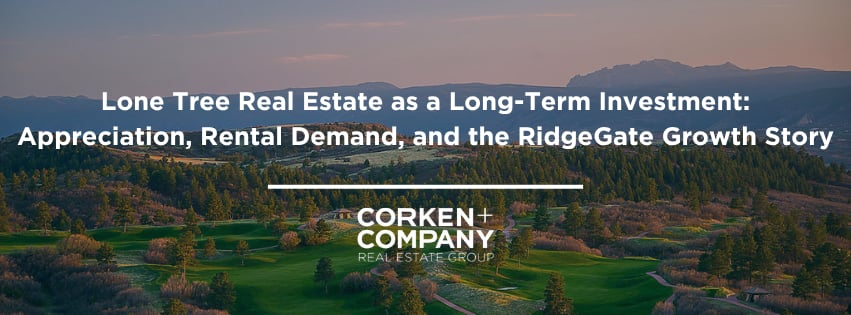
Lone Tree Real Estate as a Long-Term Investment: Appreciation, Rental Demand, and the RidgeGate Growth Story
Investment decisions in Lone Tree real estate require a different analytical frame than investments in more established, fully built-out communities. Lone Tree is not a static market. It is one of the most actively developing communities in Colorado, with a master-planned buildout of 3,500 acres that will continue evolving for the next two decades. Understanding the investment implications of that development trajectory is essential for anyone evaluating Lone Tree as a long-term hold.
The Structural Appreciation Case
Lone Tree's long-term appreciation story rests on four interlocking drivers that show no signs of weakening today.
Employment concentration anchors demand in ways that are not cyclically sensitive. Charles Schwab's Lone Tree campus is a major operational hub for one of the largest financial services companies in the country. Sky Ridge Medical Center is a flagship regional healthcare facility. CoBank, Kiewit, and a growing roster of employers in the RidgeGate business district add to an employment base that generates high-income buyer and renter demand year-round. When white-collar employment is concentrated and growing within a community, housing demand builds a floor that protects values through market cycles.
The RidgeGate buildout represents a forty-year investment in community completeness that is still in its early-to-middle phases. At buildout, RidgeGate is estimated to house 30,000 residents and 50,000 jobs across 3,500 acres. The infrastructure being built now, including the Lone Tree City Center, a second library, a second recreation center, new schools, and additional commercial density, will make the community progressively more complete and self-sufficient over time. Investors who hold property in Lone Tree are holding alongside a twenty-year infrastructure investment that increases the community's appeal and supports values in ways that neighborhoods without development momentum cannot match.
Douglas County school quality creates the persistent family demand dynamic discussed throughout this series. Families with school-age children make long-term housing commitments driven by school access. As long as Douglas County maintains its academic quality relative to peer districts, family demand in Lone Tree will remain structurally supported.
Land constraint relative to demand is building as RidgeGate approaches buildout on the west side and as the community's overall development footprint fills in. The transition from an actively developing community with abundant new construction supply to a more constrained resale market tightens the supply-demand balance in ways that support appreciation.
Rental Demand Near Major Employers
The executive rental market in Lone Tree parallels the dynamic described for Greenwood Village but with a different employer mix. Charles Schwab is the dominant employer driver, and Schwab's practice of bringing professionals from other markets generates a consistent flow of corporate relocation tenants who need quality housing near the campus for defined periods.
Sky Ridge Medical Center and its associated physician practice groups generate similar rental demand from healthcare professionals who are completing residencies, fellowships, or transition periods before establishing permanent housing. This tenant segment has strong income, professional stability, and a specific location requirement, proximity to the medical campus, that makes Lone Tree rental properties the obvious target.
Investors who acquire well-maintained properties in communities near the Charles Schwab campus and Sky Ridge Medical Center, price them appropriately for the executive rental market, and manage them with professional standards that match the tenant profile will find consistent demand and relatively low vacancy risk.
The New Construction Dynamic and Its Investment Implications
Lone Tree's ongoing new construction activity, particularly in Lyric at RidgeGate and other east-side developments, creates a specific investment consideration: resale properties compete with new construction for buyer and renter demand. Investors acquiring resale properties in communities where new construction is active need to price and present their assets at a standard that competes effectively with the new construction alternative.
The advantage resale properties offer over new construction is pricing: in many cases, a well-maintained resale property offers more square footage, an established location, and better price-per-square-foot than new construction at comparable quality levels. The disadvantage is that modern buyers and renters have calibrated expectations around contemporary finishes that older homes may not meet without investment.
The Hold Period and Exit Considerations
For investors acquiring in Lone Tree today, the appropriate hold period depends on what you are optimizing for. Short holds of two to three years are unlikely to capture the full infrastructure investment benefit that the RidgeGate buildout delivers. Longer holds of seven to fifteen years position investors to participate in the appreciation that a community moving from development-phase to established-phase typically experiences as the infrastructure matures and the community's appeal becomes self-reinforcing.
Corken + Company works with Lone Tree investors across acquisition, management, and exit strategy. Contact us at 303-858-8003 or visit corken.co. Real Estate Solutions Without Limits.