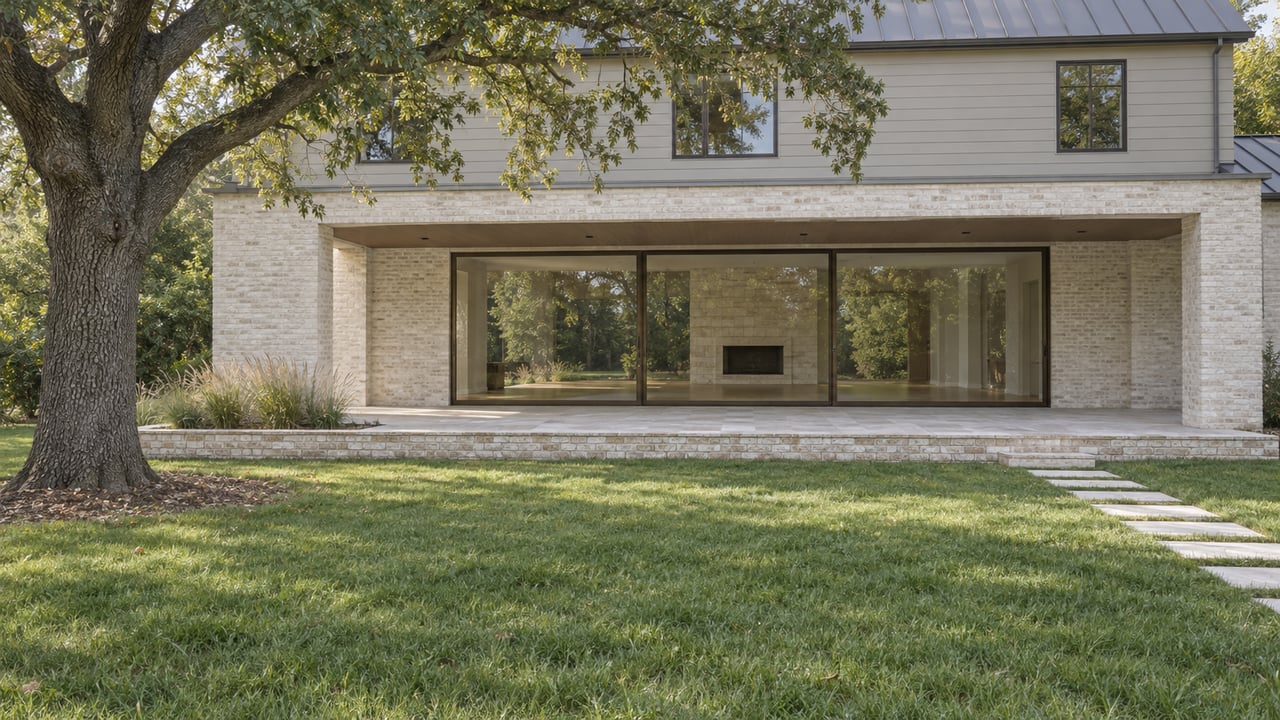
Drive the streets near the Greenwood Athletic Club and you'll pass a 1978 split-level with its original brick facade sitting three doors down from a home that didn't exist two years ago. New windows, a different roofline, a driveway still curing. Pull the listing history on both and the dollar figures land closer together than the age gap would suggest. That isn't a coincidence and it isn't a fluke of timing. It's what happens in a city where the structure on a lot is almost beside the point.
Greenwood Village has been going through what local market watchers describe as a steady wave of teardowns, concentrated in older pockets like the streets around the Athletic Club and the east side of I-25 near the Villages at Castle Pines border, where 1970s and 1980s ranch homes are being replaced one lot at a time by builders working parcel by parcel rather than through any master-planned development. There's no new subdivision going up on open land here. There's no room for one. What's happening instead is quieter and, for anyone comparing this market to a neighboring suburb, more consequential: the value sits in the ground, and the house is closer to an accessory.
The zoning code sets the floor before the builder shows up
Greenwood Village's residential zoning is built around minimum lot size, not maximum density. Depending on the district, a buildable single-family lot has to run at least 2.5 acres, at least 1 acre with 150 feet of width, or at least 22,500 square feet. In practical terms:
- R-2.5 requires 2.5 acres minimum
- R-1.0 requires 1 acre and 150 feet of lot width
- R-0.75 requires 22,500 square feet, capped at roughly 1.33 dwelling units per acre
Those numbers aren't a planning department suggestion. They're the ceiling on how many homes can ever exist on a given stretch of ground, which means the supply of buildable lots was effectively fixed decades ago and isn't expanding. When supply is locked by ordinance rather than by geography, the price of the lot itself becomes the dominant variable in almost every sale, and the condition of whatever happens to be sitting on it becomes secondary. That's the mechanism behind the split-level and the new build trading in the same range. Buyers aren't pricing the house. They're pricing a scarce, code-protected right to occupy that patch of dirt.
How hard it is to add even four homes here
The city's own approval record shows how tightly that scarcity is defended. In early 2022, Greenwood Village City Council approved the Mont Blanc Estates Subdivision, a four-home planned development on 4.73 acres at the east end of a church parking lot on Belleview Avenue. To make it work, the council had to downzone the parcel from 2.5-acre residential to a 1.0-acre PUD designation with a 30,000-square-foot minimum lot size, and the project only cleared with a new street, a shared access agreement with the adjoining church, and a round of negotiation with neighbors in the adjacent West Village subdivision over tree heights along the shared property line, according to reporting in The Villager. Four homes. One public hearing, one downzoning vote, one negotiated agreement over how tall the landscaping could grow. That's the level of process required to add a handful of lots in a city where the base zoning already runs at 1 to 2.5 acres per home.
The exception that proves how strict the rule is
The flip side of that rigidity shows up when a property doesn't conform to current standards. A recent city public-hearing notice described an R-1.0 lot that measured only 132 feet wide, short of the district's 150-foot minimum, because it had been platted before Greenwood Village incorporated. The owner needed a variance just to move forward with a replacement home. Lots like that carry hidden value because they predate the current rules, but they also carry hidden process risk, since anything that doesn't match the zoning envelope has to go through the same public hearing machinery as a new subdivision. For a buyer, an oversized or oddly configured older lot can be an opportunity. It can also be a longer runway to permit approval than the listing photos suggest.
Why three different 2026 reports can't agree on the median
Pull recent market reporting on Greenwood Village and the median price depends entirely on which slice of the zoning map got sampled. One local market report puts the 2026 median for single-family homes in the $1.1 million to $1.4 million range, with entry-level homes closer to the E-470 corridor starting around $800,000 to $950,000, while custom estates on half-acre-plus lots along the Willow Springs Golf Course corridor and in sections like the Preserve routinely list from $2 million to $4 million and up. Attached product, the condos and townhomes clustered near the DTC core, runs $450,000 to $750,000, a segment that pulls the citywide average down every time it's blended with the acreage estates. As of late July 2026, one widely used home-value index put the citywide average at just over $1.36 million, up 1.6% over the year. Separate listing data from June 2026 pegged the median list price near $1.48 million at roughly $451 per square foot with a median 45 days on market, while another market read for the second quarter of 2026 placed the working median closer to $1.85 million at about $528 per square foot with days on market running near 38.
None of those numbers are wrong. They're measuring different lots. A townhome near the DTC light rail stop and a half-acre teardown lot near the Athletic Club are not the same asset class wearing a different price tag, and blending them into one median is why the reported figure moves depending on which report you're holding. The useful comparison isn't citywide median to citywide median. It's zoning district to zoning district, lot to lot.
The one deadline that could rewrite the math
Here's the part that changes the calculus for anyone underwriting Greenwood Village on the assumption that its scarcity is permanent. In 2024, the Colorado legislature passed House Bill 24-1313, which requires designated transit-oriented communities to hit a "housing opportunity goal" calculated at an average of 40 dwelling units per acre across their transit-area acreage. Greenwood Village's own government has stated that meeting that formula around its RTD stops would produce roughly ten times the housing stock currently allowed there, and that parcels under five acres could be rezoned to that density without the public hearing process the city currently requires for something as modest as a four-lot subdivision.
Greenwood Village didn't wait to find out. It joined five other home-rule cities (Aurora, Arvada, Glendale, Lafayette and Westminster) in suing the state in Denver District Court, arguing that land use and zoning are matters of exclusive local concern under Colorado's home-rule constitutional provision and that the law is retroactive in ways the state constitution doesn't allow. The reporting deadline under HB 24-1313, the date by which transit-oriented communities have to identify displacement and affordability strategies and submit a housing opportunity goal report to the state, lands December 31, 2026. That's three months from now.
None of this means the zoning that currently makes a Greenwood Village lot valuable is about to disappear. It means the assumption that R-1.0 and R-2.5 minimums are permanent, unchangeable facts is currently being tested in court, on a clock, for parcels specifically near the transit corridors that run through the DTC side of the city. Anyone treating today's zoning map as a fixed input for a ten-year hold should know that input has an open legal question attached to it right now.
What this means before you write an offer
If land is doing most of the pricing work in Greenwood Village, the due diligence has to start at the parcel, not the listing photos. Confirm the zoning district for the specific address, not the neighborhood in general, since R-2.5, R-1.0 and R-0.75 parcels can sit blocks apart. Check whether the lot's actual dimensions conform to the district's width and area minimums or whether it's one of the older, pre-incorporation plats that would need a variance for a rebuild. And if the property sits anywhere near the DTC transit corridor, it's worth asking whether the parcel falls inside the transit area map the state is using for its HB 24-1313 calculations, since that's the zone where the density formula would apply first if the litigation doesn't hold. Greenwood Village's planning department will issue a formal zoning verification letter for a specific address through its online portal, and that's a five-minute request that answers a question no comp sheet can.
The house on the lot is real and it matters to livability, but in this market it is not what's setting the number on the contract. The zoning district is.
If you're weighing a Greenwood Village lot against something in Cherry Hills Village or Centennial and want a clear read on what that specific parcel's zoning actually allows before you write an offer, Corken & Company can pull the district, the comps, and the transit-area overlay together in one conversation. Schedule your concierge consultation and know exactly what you're bidding on.